
How to Search Franklin County Court Records
Franklin County runs more than one record system, and the right one depends on the court. Felony and large civil cases live in the Clerk of Courts Case Information Online (CIO) tool. Traffic, misdemeanor, and small civil cases are kept by the Municipal Court Clerk. Estates, guardianships, name changes, and marriage records are searched through the Probate Court. The county's own public records page routes case requests to these three places. So the first step is always to figure out which court heard the matter.
Before you start, gather a name or a case number. A case number is faster. Name searches work too, but common names return long lists, so a date range or court type helps narrow things down. Each portal is free to use.
The county explains its routing on the Common Pleas public records page, which sends case documents to CIO, Municipal records to the Municipal Clerk, and probate matters to the Probate Court.
This Common Pleas public records page shows how Franklin County splits record requests across its courts.
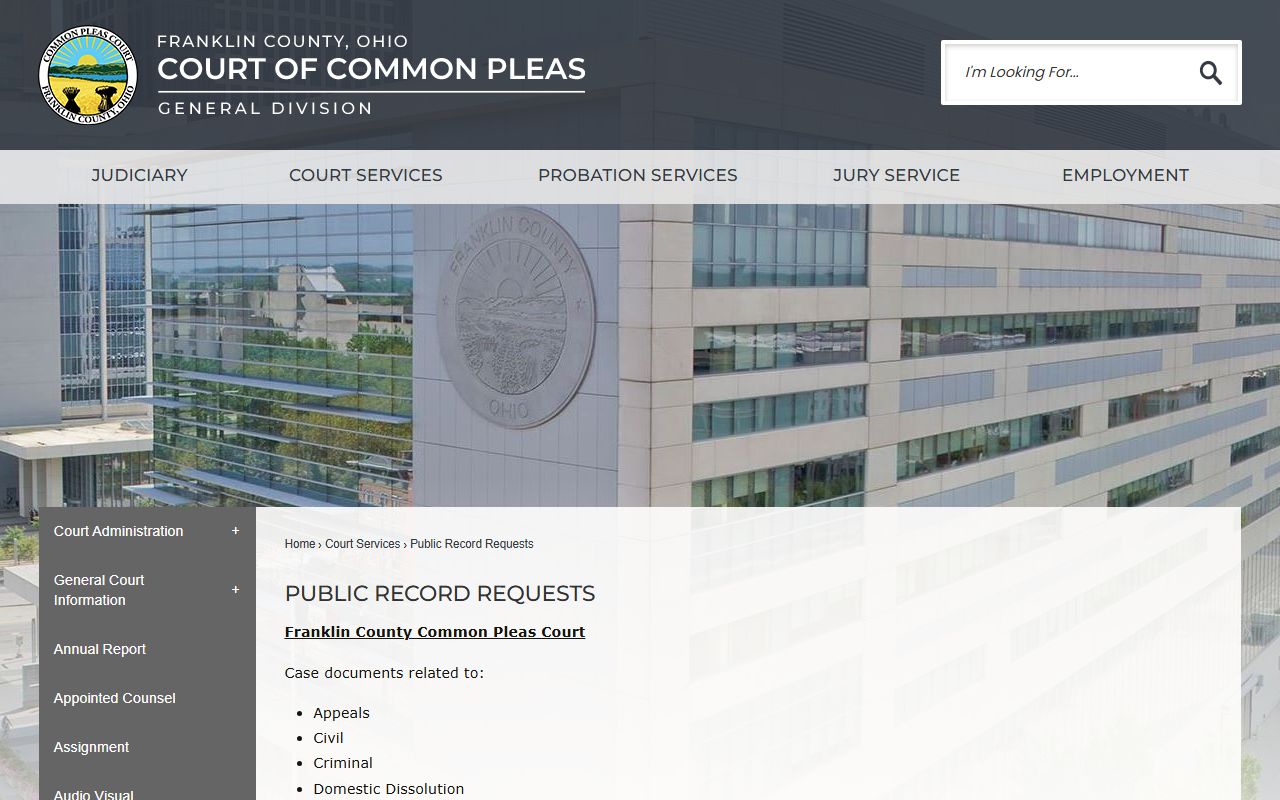
That routing matters because asking the wrong office slows you down. When in doubt, start with the Clerk of Courts and ask staff which court holds the file.
- Pick the right court: Common Pleas, Municipal, or Probate.
- Open that court's free search portal.
- Enter a party name, or a case number if you have one.
- Narrow by court type, case type, or filing date.
- Open the docket, then request a certified copy if you need one for legal use.
Franklin County Court Records Search Fields
The main tool for Common Pleas records is the Clerk's Case Information Online system. It covers General Division civil and criminal cases, Domestic Relations cases, and Tenth District appeals. You can run a name search or a case-number search. The fields below come straight from the live search screen.
| Field Label | Type | Required | Notes / Format |
|---|---|---|---|
| Last Name | Text | Optional | Up to 25 characters; used for name search. |
| First Name | Text | Optional | Up to 14 characters. |
| Court | Dropdown | Optional | All, Appeals, Civil, Criminal, Domestic. |
| Case Year | Text | For case search | Two-digit year. |
| Case Type | Dropdown | For case search | Codes like CV, CR, DM, DR, AP. |
| Filed From / To | Date | Optional | MM/DD/YYYY range to narrow results. |
The case-type codes are worth knowing. CV is civil, CR is criminal, DM is dissolution, DR is divorce, and AP is appeals. Pick the code that fits the matter you want.
The Franklin County Judicial System
Ohio places its trial power in the Court of Common Pleas, and every county has one. Franklin County's Common Pleas Court has a General Division, a Domestic Relations and Juvenile Branch, and a Probate Court. The General Division hears felony crimes and civil cases over $15,000. Below it sits the Franklin County Municipal Court, which handles traffic, misdemeanors, and civil claims of $15,000 or less. Appeals travel up to the Tenth District Court of Appeals in Columbus, and from there to the Supreme Court of Ohio.
The General Division is the main felony and high-value civil court. The Municipal Court is a court of record with fourteen General Division judges and one Environmental Division judge, according to its about page.
Case flow: Municipal Court › Court of Common Pleas › Tenth District Court of Appeals › Supreme Court of Ohio
The General Division's jurisdiction and role are stated on the Franklin County Common Pleas General Division site.
You can read more about each trial court on the Court of Common Pleas and Municipal Court pages.
| Court | Jurisdiction | Case Types |
|---|---|---|
| Common Pleas, General Division | Felonies; civil over $15,000 | Criminal, civil, administrative appeals |
| Domestic Relations & Juvenile | Family and juvenile matters | Divorce, custody, support, delinquency |
| Probate Court | Estates and personal status | Wills, guardianships, marriage, name changes |
| Municipal Court | Civil up to $15,000 | Traffic, misdemeanors, small civil, code cases |
| Tenth District Court of Appeals | Appellate review | Appeals from Franklin County trial courts |
Franklin County Courthouses
The courts share a vertical downtown complex along South High Street near Fulton, Front, and Mound Streets. The General Division Courthouse is at 345 S. High Street. Probate, Domestic Relations, and Juvenile share 373 South High Street on different floors. The Municipal Court sits just south at 375 S. High Street. Each building keeps its own hours, but most run Monday through Friday, 8:00 a.m. to 5:00 p.m.
The county's building page describes the Common Pleas courthouse and its downtown location.
The Common Pleas courthouse building page covers the General Division's home.
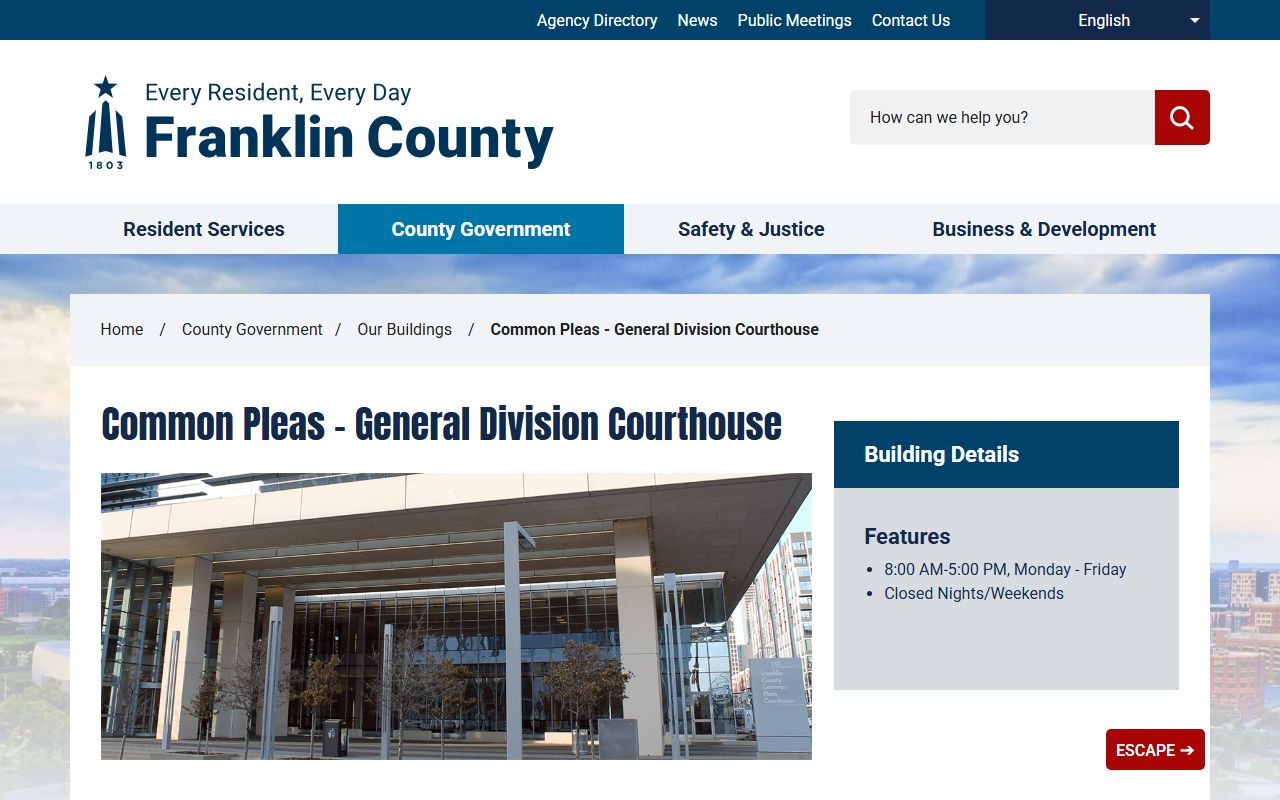
Floors matter in this complex, so confirm the floor before you visit.
Common Pleas, General Division
345 S. High Street, 1st Floor
Columbus, OH 43215
614-525-3621
Domestic Relations & Juvenile
373 S. High Street, 4th Floor
Columbus, OH 43215
614-525-3628
Franklin County Probate Court
373 S. High Street, 22nd Floor
Columbus, OH 43215
614-525-3894
Types of Court Records Available in Franklin County
The county produces many kinds of court records, and each comes from a different division. Civil and criminal Common Pleas files come from the General Division. Family files come from Domestic Relations. Estates and marriage records come from Probate. Traffic and misdemeanor files come from the Municipal Court. Knowing the source tells you where to search and who keeps the certified copy.
The Clerk's General Division page lays out civil and criminal Common Pleas records and how they are organized.
The Clerk's General Civil and Criminal page describes the Common Pleas records the office keeps.
Use the list below as a quick map of record types and where they live.
- Criminal records - Felony files at Common Pleas; misdemeanors at Municipal Court.
- Civil records - Large cases at Common Pleas; claims up to $15,000 at Municipal Court.
- Family and divorce records - Divorce, custody, and support at Domestic Relations.
- Probate records - Estates, guardianships, name changes, and marriage at Probate.
- Traffic records - Citations and OVI matters at the Municipal Court.
What Franklin County Court Records Show
A case file is built from many parts. The docket lists every filing and order in date order. Party fields name who is involved. Status fields show whether a case is open, closed, or set for a hearing. Money fields list fines, costs, and bond. Knowing the fields helps you read a record without a lawyer.
| Field | What It Shows |
|---|---|
| Case Number | Year, case-type code, and sequence that identify the file. |
| Filing Date | When the case opened or a document was filed. |
| Parties | Plaintiff, defendant, petitioner, or respondent, plus attorneys. |
| Charges / Cause | The crime charged or the civil claim raised. |
| Disposition | The outcome, such as guilty, dismissed, or judgment entered. |
| Sentence / Judgment | The penalty, money award, or court order. |
Some fields stay blank while a case is active. Others fill in only after a judge rules.
Public Access Laws for Franklin County Court Records
Ohio treats government records as open by default. The main law is the Ohio Public Records Act, and court files follow the Rules of Superintendence for the Courts of Ohio. The Clerk's own policy mirrors the state rule. You do not have to put a request in writing, prove who you are, or say why you want a record. The request just has to name the records clearly enough for staff to find them.
Disputes over a denied request can go through a streamlined process at the Ohio Court of Claims, or through a mandamus action in court. Most routine requests never reach that point.
Key Statutes:
Ohio Revised Code § 149.43 - The Public Records Act; defines public records and requires prompt access and copies.
Ohio Revised Code § 2743.75 - A fast Court of Claims path for public-record disputes.
Ohio Revised Code § 2953.32 - Sets out sealing and expungement of eligible criminal records.
Records That Are Restricted or Confidential
Open access has limits. Some files are closed by law to protect children, victims, and private data. Juvenile records carry more restrictions than adult files. Adoption, mental illness, and developmental disability records held by Probate are confidential and not open for public view. Sealed and expunged criminal records drop out of public access once a judge grants the order. Social Security numbers and account numbers are redacted from filings.
To view a sealed file, a person usually has to be a party, an attorney of record, or an agency with a legal right under statute. Anyone else generally needs a court order. The right place to ask is the court that heard the case, since the custodian and forms differ between Common Pleas and Municipal Court.
Specialty Courts in Franklin County
Franklin County runs specialized dockets that aim at the cause behind a case, not just the charge. The Municipal Court lists programs for justice-involved veterans, people with mental health diagnoses, people with drug addiction, and people who have been sexually exploited. These dockets use individualized plans, weekly check-ins with the docket judge, regular probation contact, and randomized drug testing. Completion can lead to charges being vacated or dismissed.
The Domestic Relations and Juvenile Branch runs its own specialty dockets, including Juvenile Recovery Court, Family Recovery Court, and Empowerment Court, which celebrated graduates in 2025. These programs connect families and youth to treatment and support while the legal case moves forward.
Most programs ask for about two years of active work and a referral from a defense attorney, prosecutor, or judge.
Franklin County Sheriff and Jail Records
The Franklin County Sheriff's Office runs county custody and publishes a current-inmate search. Dallas Baldwin serves as Sheriff. The office's inmate lookup shows current inmates, current charges, current case numbers, the location for visitation, and court dates. The Sheriff warns that bond details should still be confirmed through the Clerk of Courts, since the jail system is not the bond authority.
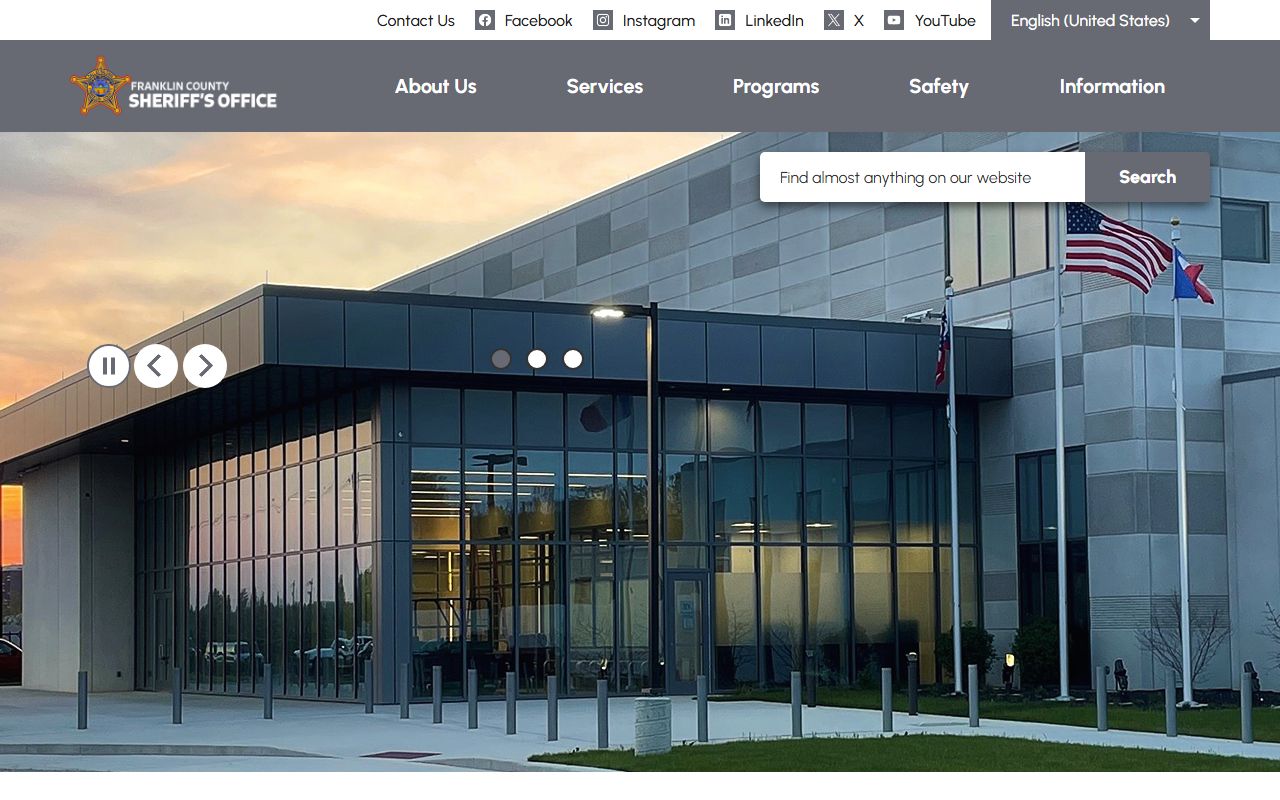
The Sheriff's main site links the inmate search, visitation rules, and public records.
The Franklin County Sheriff's Office site is the hub for inmate and custody information.
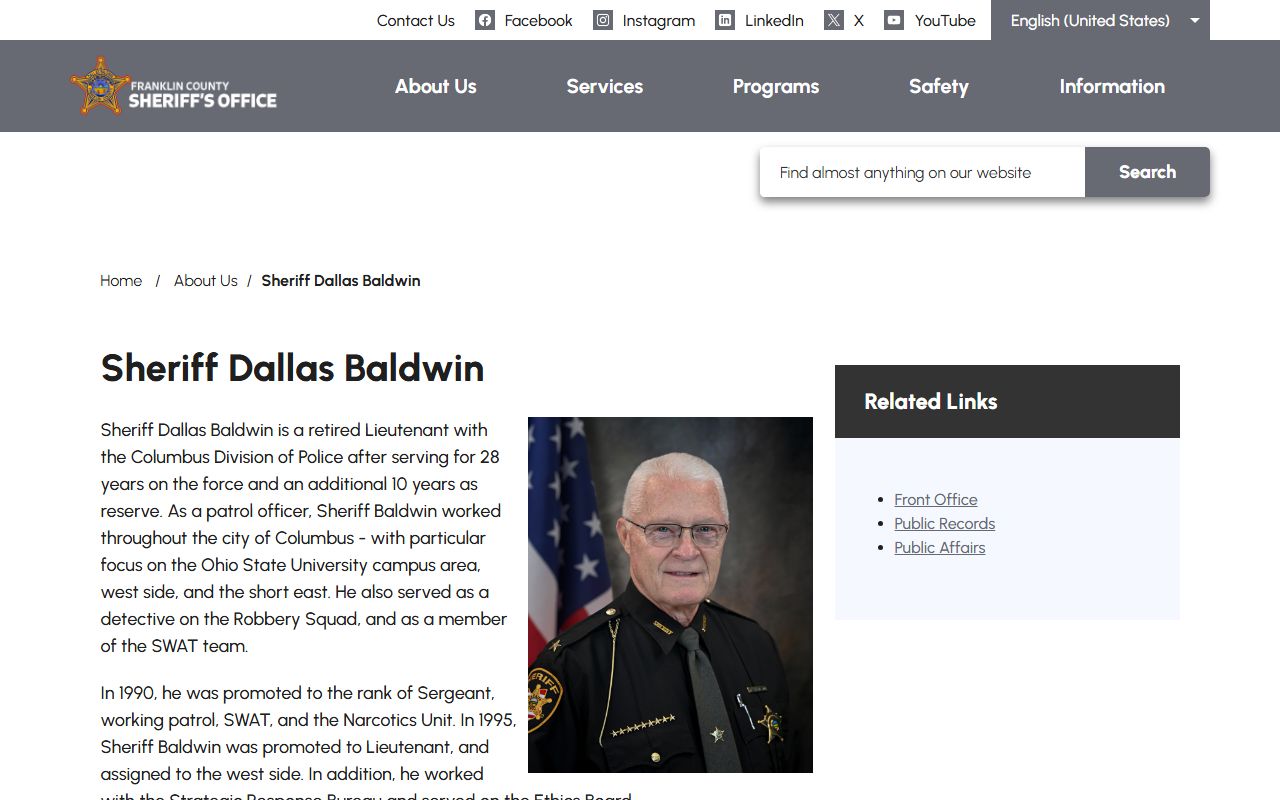
The office also publishes a short biography of the elected Sheriff.
You can confirm the Sheriff's role and contact path on the Sheriff biography page.
For the full roster details, see the Franklin County inmate records page, and for active warrants see warrant records.
Marriage, Divorce, and Probate Records
The Probate Court issues marriage licenses and keeps marriage records back to 1803, with online records from January 3, 1995 forward. Divorce and dissolution files are handled by Domestic Relations and searched through CIO. Estates and guardianships also run through Probate. For details, see marriage and divorce records and probate records.
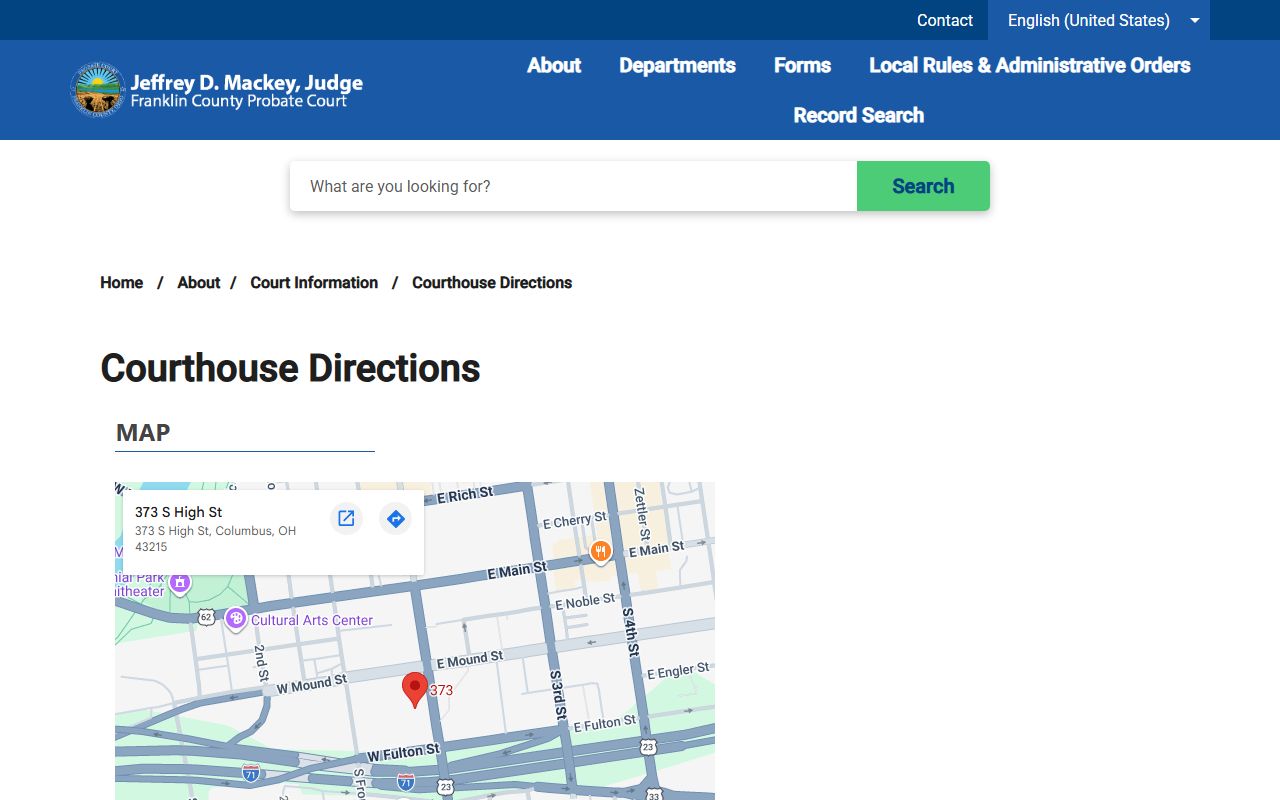
The Probate Court directions page helps visitors find parking and the courthouse.
The Probate courthouse directions page lists parking and access details.
A few probate terms come up often, so plain definitions help.
- Testator
- A person who makes a will.
- Executor
- The person named to carry out a will and settle the estate.
- Guardian
- A person the court names to manage a minor's or incapacitated adult's affairs.
How to Interpret Franklin County Court Records
Court files use shorthand that can confuse a first-time reader. A charge is not a conviction. A docket entry like "capias" means a warrant was issued for a missed appearance. "Disposition" is the result of a charge or case. A status of "closed" does not always mean a case is fully resolved, as the Municipal Clerk notes in its help text. Reading the docket from the bottom up shows how a case moved over time.
When a code is unclear, check the portal's own legend. CIO and the Municipal search both list their case-type and status codes.
Accuracy and Record Limitations
Online court data is helpful but not always current to the minute. Probate case search, for example, is current only as of the previous day, and it can be down during nightly backups between 10 p.m. and 2 a.m. Warrant clearance and new filings may take time to appear. For a high-stakes use, confirm the detail with the court that holds the file.
Note: Always confirm a name, date, or disposition with the originating court office before you rely on an online record for any legal or financial decision.
Franklin County Court Records Fees
Looking at a record in person during business hours is free. Copies and certified records can carry a fee, and the amount depends on the office and the record. The Clerk's public records policy says small or readily electronic records are processed as fast as staff and equipment allow. Marriage and auto-title fees are set, while some court copy fees are quoted at the counter.
| Item | Amount |
|---|---|
| Public inspection in office | Free |
| Marriage license | $65.00 |
| Certified marriage abstract | $2.00 per copy |
| Auto title record copy | $5.00 |
Confirm court case copy fees with the relevant clerk before you visit, since those vary by record.
History of Franklin County Courts
Ohio created Franklin County on March 30, 1803, the same year the state joined the Union. Columbus became the county seat and later the state capital, which is why the county's court system sits beside state government and federal courts downtown. The Common Pleas Court traces back to Ohio's earliest judicial design. Over the years the complex grew into a cluster of high-rise buildings holding the General Division, Probate, Domestic Relations, Juvenile, the Municipal Court, and the Tenth District Court of Appeals.
Probate's record holdings show the system's age. The court keeps marriage records from 1803, birth and death records from 1867 to 1908, and estate and guardianship records from 1898 forward.
Frequently Asked Questions
How do I search Franklin County Common Pleas records?
Use Case Information Online from the Clerk of Courts. Search by name with a court category, or by case number using the year, case-type code, and sequence. The court options are All, Appeals, Civil, Criminal, and Domestic. For help, the Clerk lists 614-525-3600.
What court handles traffic tickets in Franklin County?
The Franklin County Municipal Court handles traffic cases within its area. You can search the Municipal Clerk portal by ticket number, case number, or name. The court also hears misdemeanors and civil claims of $15,000 or less.
Where do I get a marriage license?
The Probate Court Marriage Department issues licenses on the 23rd Floor at 373 South High Street. Both parties complete an online application first, then appear in person. The fee is $65, and the last license each day is issued at 4:00 p.m.
More on the Franklin County Court Records FAQ page.