
How to Search Franklin County Traffic Court Records
Traffic cases run through the Franklin County Municipal Court. The Clerk of that court keeps a free public case search. It shows court dates, the amount due, warrant status, parties, and case status. You do not need an account. A ticket number is the cleanest way in, since one ticket points to one case.
The Franklin County Municipal Court Clerk case search is the official portal for traffic, criminal, and civil Municipal records.
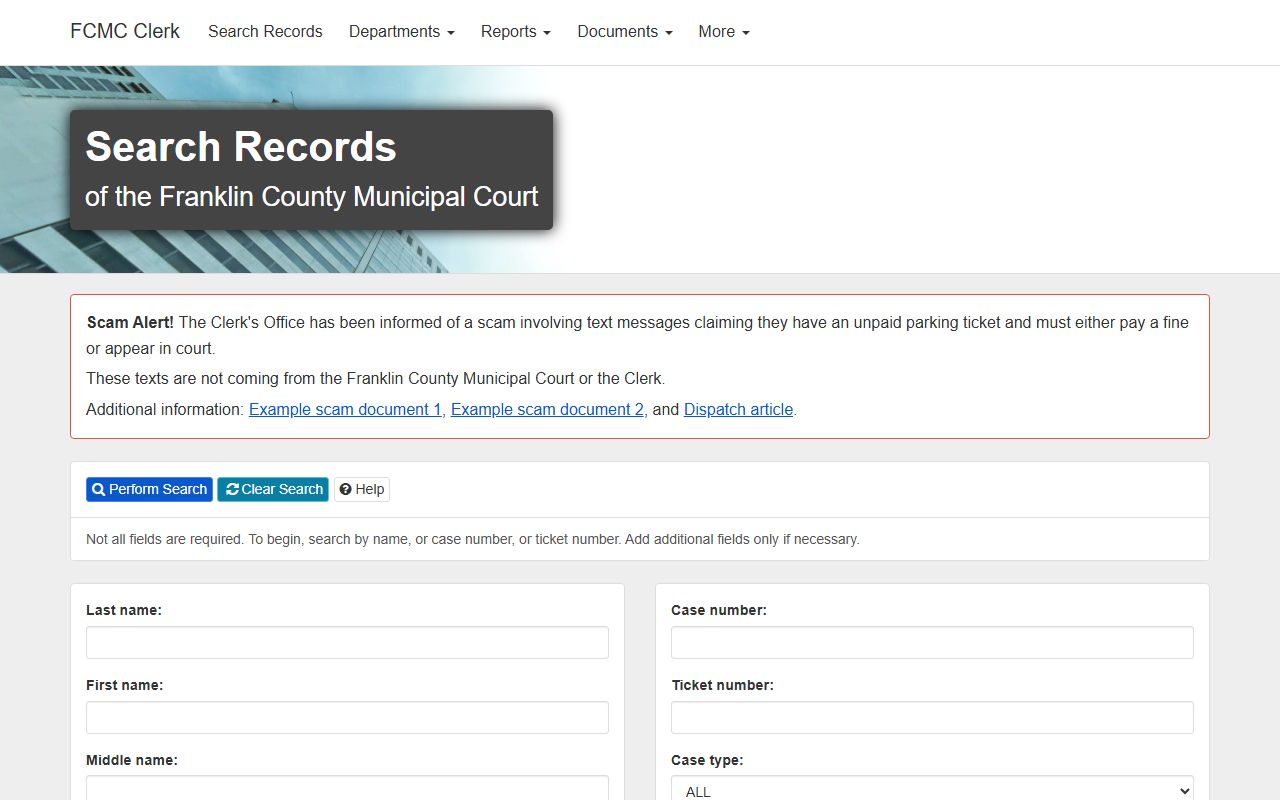
The form opens with a few starting routes, and the help text tells you to begin with one of them before adding filters. Once a case loads, the docket lists each filing in date order.
- Open the Municipal Court Clerk case search.
- Enter a ticket number, a case number, or a last name plus first name.
- Add Case Year or Case Type only if a name returns too many hits.
- Open the matching case and read the docket.
- Check the court date, amount due, case status, and any warrant flag.
For a broader view across all county courts, the Franklin County court records page maps each portal to its court.
Which Courts Handle Traffic Cases
The Franklin County Municipal Court handles traffic cases within its jurisdiction. The court sits at 375 S. High St., Columbus, OH 43215, phone 614-645-8214. It also hears misdemeanor criminal cases and civil cases of $15,000 or less. The court has fourteen General Division judges and one Environmental Division judge.
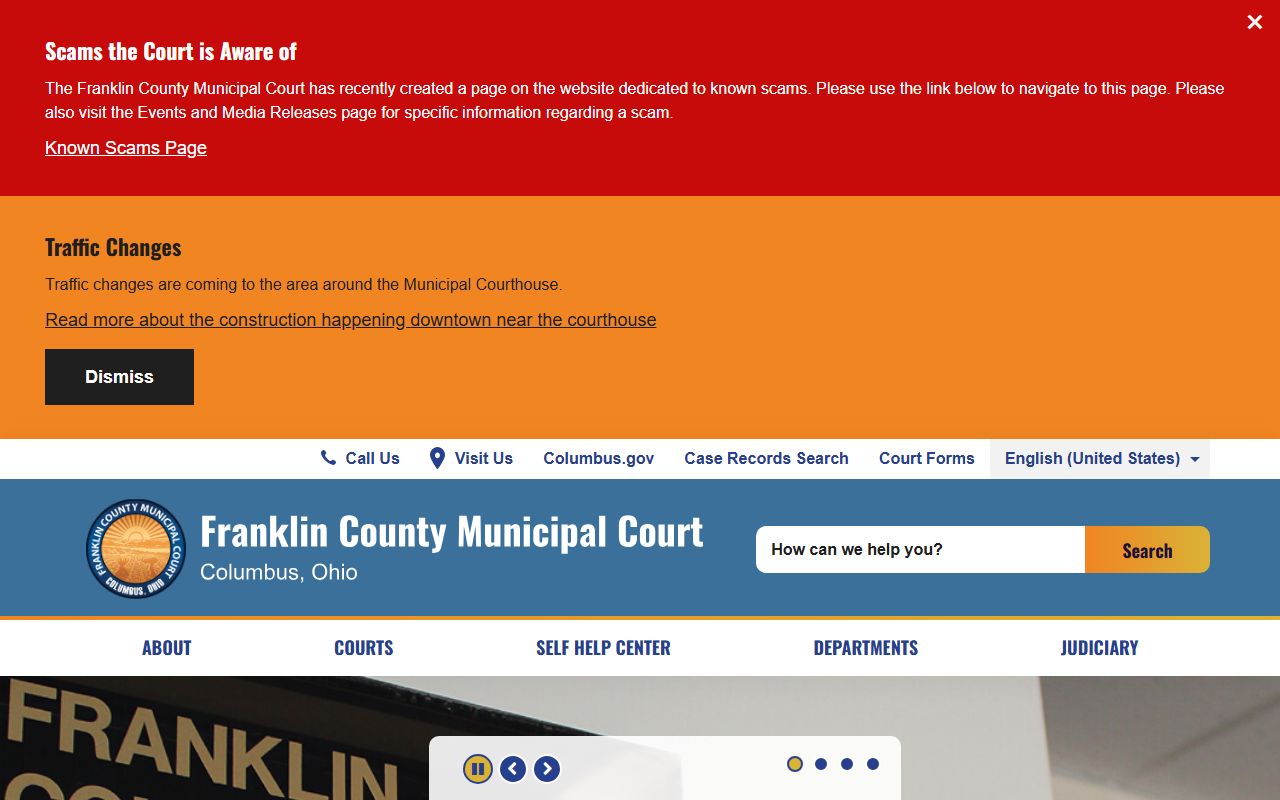
The Franklin County Municipal Court about page lays out the court's jurisdiction, address, and hours.
Not every traffic matter lands in Municipal Court. A juvenile traffic case goes through the Domestic Relations and Juvenile Branch instead, handled by the main Clerk of Courts at 373 South High Street, 4th Floor. Mayor's courts in smaller towns can hear certain local traffic matters, but those are not courts of record, and a person can ask for rehearing in the municipal or county court. For most adult drivers cited in the Columbus area, the Municipal Court is the right place to look.
Types of Traffic Cases on Record
Traffic files cover a wide range. Some are minor. Some carry jail time. The Municipal Court records include moving and non-moving violations, parking and ticket matters in applicable jurisdictions, and traffic misdemeanors. More serious charges, like impaired driving, show up as criminal/traffic cases.
The case-type split matters when you search. In the Municipal portal, Case Type can be set to Civil or Criminal/Traffic. Traffic citations fall under the Criminal/Traffic side. The list below gives a sense of what the court hears.
- Speeding and other moving violations.
- Non-moving violations, such as equipment or registration tickets.
- Traffic misdemeanors, including some reckless or repeat offenses.
- OVI, the Ohio term for impaired driving, handled as criminal/traffic.
- Commercial driver violations tied to a CDL.
- Parking and ticket matters where the court has jurisdiction.
A single stop can produce more than one charge, so one case may list several citations. The docket shows each charge and its outcome.
What Franklin County Traffic Court Records Show
A traffic record is more than a fine. It holds the case or ticket number, the parties, the charge, the court dates, and the money owed. It also shows case status and warrant status, which matter if you missed a date. The table below lists the fields you will most often see in a result.
| Field | What It Shows |
|---|---|
| Case / Ticket Number | The year, case code, and sequence that name the file. |
| Parties | The cited driver, the city prosecutor or officer, and any owner. |
| Charge / Citation | The violation or violations filed in the case. |
| Court Date | The next or last hearing or arraignment date. |
| Amount Due | Fines, court costs, and any unpaid balance. |
| Warrant Status | Whether a warrant or capias is active on the case. |
| Case Status | Open, closed, diversion, jail, reopen, and similar codes. |
| Disposition | The outcome of each charge once the court rules. |
Some fields stay empty until a judge or magistrate acts. The docket fills in as the case moves through the court.
Franklin County Traffic Record Search Fields
The Municipal citation lookup offers many fields, but not all are required. The Clerk says to begin with one route, then add detail only if needed. The table below lists the fields from the live portal.
| Field Label | Type | Required | Notes / Format |
|---|---|---|---|
| Last name | Text | With first name | Required with first name for a name search. |
| First name | Text | With last name | Required with last name for a name search. |
| Middle name | Text | No | Try the first letter only; middle name is not always present. |
| Date of birth | Date | No | Use slashes, MM/DD/YYYY, such as 05/25/2006. |
| Company name | Text | Conditional | Can satisfy the required criteria; try name variations. |
| Party type | Dropdown | No | All, Defendant, Plaintiff, and other party roles. |
| Case number | Text | Conditional | Year, three-letter case code, six-digit sequence. |
| Ticket number | Text | Conditional | Include letters, such as REY54321. |
| Case type | Dropdown | No | All, Civil, Criminal/Traffic. |
| Case year | Number | No | Four-digit year. |
| Case status | Dropdown | No | All, Open, Closed, Diversion, and more. |
Note: The lookup needs one of four starting routes, so a year or party type by itself will not run a search.
Searching by Citation Number vs Name
Two paths lead to the same case. One uses the ticket or case number. The other uses a name. Each fits a different situation, and the right pick saves time.
The citation route is the most efficient. One ticket number points to one case, with no guessing. Ticket numbers include letters, such as REY54321. A Municipal case number uses a four-digit year, a three-letter case code, and a six-digit sequence, like 2027 TR C 123456 for a traffic file. If you hold the paper ticket, the number is printed on it.
The name route helps when the ticket is lost. Type a last name plus a first name. A common name can return a crowd, so narrow with Case Year, Case Type, or Party Type. The middle-name field can help, though the court suggests trying just the first letter because middle names are not always on file. Add a date of birth if the list is still long.
Note: A closed status does not always mean a case is finished, so open the docket detail and check the amount due and any warrant flag.
Paying or Contesting a Franklin County Traffic Ticket
A ticket leaves you two basic choices. You can pay it, which usually admits the violation. Or you can contest it and appear in court. The case record shows your court date and the amount due, so start there before you decide.
The Clerk has posted a scam alert about texts claiming an unpaid parking ticket or a required court appearance. Pay only through official court links or in person on the 4th Floor at 375 South High Street. The court will not text you a payment link. The steps below outline the process.
- Search the Municipal Clerk portal by ticket number.
- Review the court date, amount due, and warrant or status information.
- Pay only through official Municipal Clerk or court links; beware scam texts.
- To contest, follow the ticket or court instructions and appear or file as directed.
- If a warrant or status issue appears, contact the Municipal Clerk or counsel.
If you cannot afford a lawyer for a charge that carries jail time, the Franklin County Municipal Court Public Defender may be able to help. For questions about which clerk holds your file, the Municipal Court Clerk page covers the office in full.
Public Access Laws for Traffic Court Records
Ohio law presumes court records are open. The Ohio Public Records Act, Ohio Revised Code § 149.43, requires prompt inspection and copies within a reasonable time. Court files also follow the Ohio Rules of Superintendence, which set the presumption of access and the rules for redaction.
For most traffic cases, that means open access. You can look one up without giving your name, proving who you are, or stating a reason. Personal identifiers are redacted from filings. If a request is denied, a fast path exists at the Ohio Court of Claims under Ohio Revised Code § 2743.75. Juvenile traffic cases follow tighter rules and may need party or attorney status to view.
Other county courts run their own public search portals, which can look similar but cover different records. As a contrast, the Franklin County Probate general case search is a separate portal for estates, guardianships, and name changes, not traffic cases.
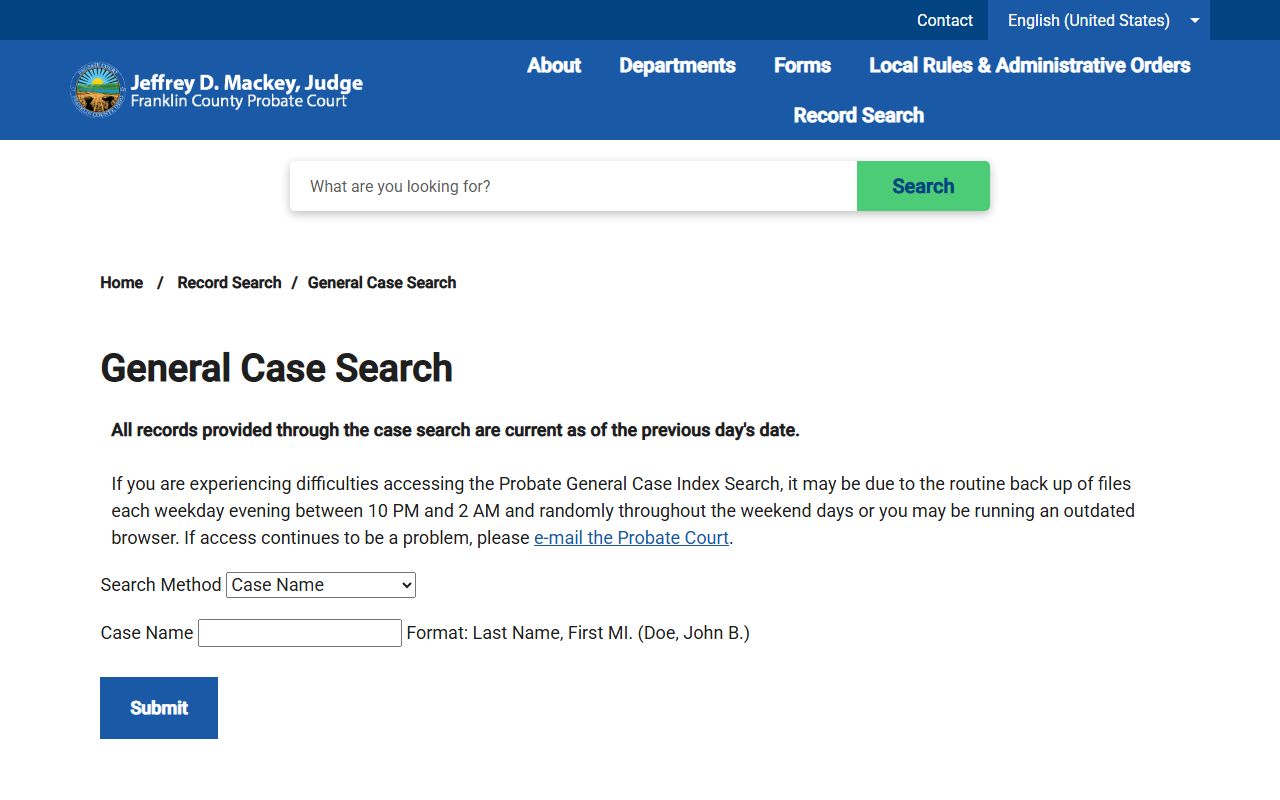
The takeaway is simple. Each court keeps its own files, so a traffic search belongs in the Municipal portal, not the Probate one.
Court Traffic Records vs State Driver Records
This trips up a lot of people. The court traffic record and the state driver record are two separate files kept by two separate offices. They overlap, but they are not the same, and you may need both.
The court file lives with the Municipal Court Clerk. It shows the case, the charge, court dates, and money owed. The state driver record lives with the Ohio Bureau of Motor Vehicles. It shows license status, points, suspensions, and reinstatement steps. A conviction in court gets reported to the BMV, which then updates the driver record. The comparison below breaks down the difference.
| Point | Court Traffic Record | State Driver Record |
|---|---|---|
| Record source | Franklin County Municipal Court Clerk | Ohio Bureau of Motor Vehicles |
| What's in it | Case, ticket, charge, court dates, amount due, status, disposition | License status, points, suspensions, reinstatement requirements, reportable convictions |
| Where to access | fcmcclerk.com case search | Ohio BMV; BMV portal not inspected in this research |
| How to correct errors | File with the court that heard the case | Work through the Ohio BMV process |
If your court case looks right but your license still shows a problem, the fix runs through the BMV, not the court. The opposite is also true.
CDL and Commercial Driver Records
Commercial drivers face stricter rules. A violation in a personal car can still hit a commercial driving license, or CDL. Some offenses that a regular driver might shrug off can put a CDL holder out of work.
In the Municipal Court search, a commercial driver case looks like any other traffic file. It carries a case or ticket number, a charge, court dates, and a disposition. The difference shows up on the state side. The Ohio BMV tracks CDL status, points, and disqualifications on the driver record, which is separate from the court file. A driver who needs to confirm CDL standing should pull both the court record and the BMV record.
Note: The court file shows the case outcome, but CDL points and disqualifications appear on the separate Ohio BMV driver record.
DUI and OVI Cases
Ohio calls impaired driving OVI, short for operating a vehicle impaired. It is more serious than a routine ticket. An OVI charge runs as a criminal/traffic case, so it carries the weight of a criminal matter on top of the traffic side.
Because of that, OVI files cross into criminal territory. The case can involve jail time, license suspension, and a criminal record, not just a fine. For the criminal side of these charges, the Franklin County arrest records page covers booking, charges, and how criminal cases are searched.
Deferred Adjudication and Driving Course
Some drivers can avoid the worst of a ticket. Diversion shows up as a case status in the Municipal search, which signals a path other than a straight conviction. These programs vary by charge and by the judge.
A driving course or a diversion track can sometimes reduce points or keep a charge off the final record if a driver completes the terms. The court sets the conditions, and the docket records progress. The exact eligibility rules depend on the offense and are decided case by case, so the case file and the court are the right places to confirm what applies. The state driver record still follows its own reporting rules through the BMV.
Sealing or Expunging Traffic Records
Ohio lets eligible people seal or expunge certain records. Once a court grants the order under Ohio Revised Code § 2953.32, the record drops out of public access. Not every traffic matter qualifies, and many minor traffic offenses are treated differently from criminal cases.
The court reviews eligibility, waiting periods, and any disqualifying factors before it rules. You file in the court that heard the case, so a Municipal traffic case goes through the Municipal Court, not the main county Clerk. The two offices keep separate files and forms. After an order is granted, sealed records may still be inspected by certain officials under Ohio Revised Code § 2953.34.
Fees for Traffic Record Copies
Looking up a traffic case online is free. Getting a paper or certified copy is where fees come in. The court did not publish a fixed price list for court copies in the official pages reviewed, so the exact amount is quoted at the counter.
There are two copy types. A plain copy works for reference. A certified copy carries the clerk's seal and is the version courts and agencies accept as proof. The table below sets out what is known.
| Item | Fee |
|---|---|
| Online case lookup | Free |
| Public inspection in person | Free during business hours |
| Plain copy of a court file | Quoted at the counter |
| Certified copy of a court file | Quoted at the counter |
Bring the case or ticket number to speed the request. For payment safety and the full clerk profile, see the Municipal Court Clerk page, and for the court itself, the Franklin County Municipal Court page.