
Official Franklin County Warrant Sources
There is no single button that lists every open warrant in the county. The work is split among three offices, and each one holds a different slice. The Sheriff handles wanted persons and serves many warrants. The Court of Common Pleas tracks felony warrants and capias orders on its case dockets. The Municipal Court tracks warrant status on traffic, misdemeanor, and civil cases. Pick the office that fits the case, then search there.
Use only government sites for this. The Sheriff lists wanted people on an official page run by his office. Court warrant entries show up inside the same case-search tools that hold the rest of the file. Anything that asks you to pay a fee to clear or to view a warrant is not the county. Treat those as scams, every time.
The Sheriff's Wanted Persons page is the public starting point for people the office is looking for.
The Franklin County Sheriff Wanted Persons page lists individuals the Sheriff's Office is seeking and gives contact lines for tips.
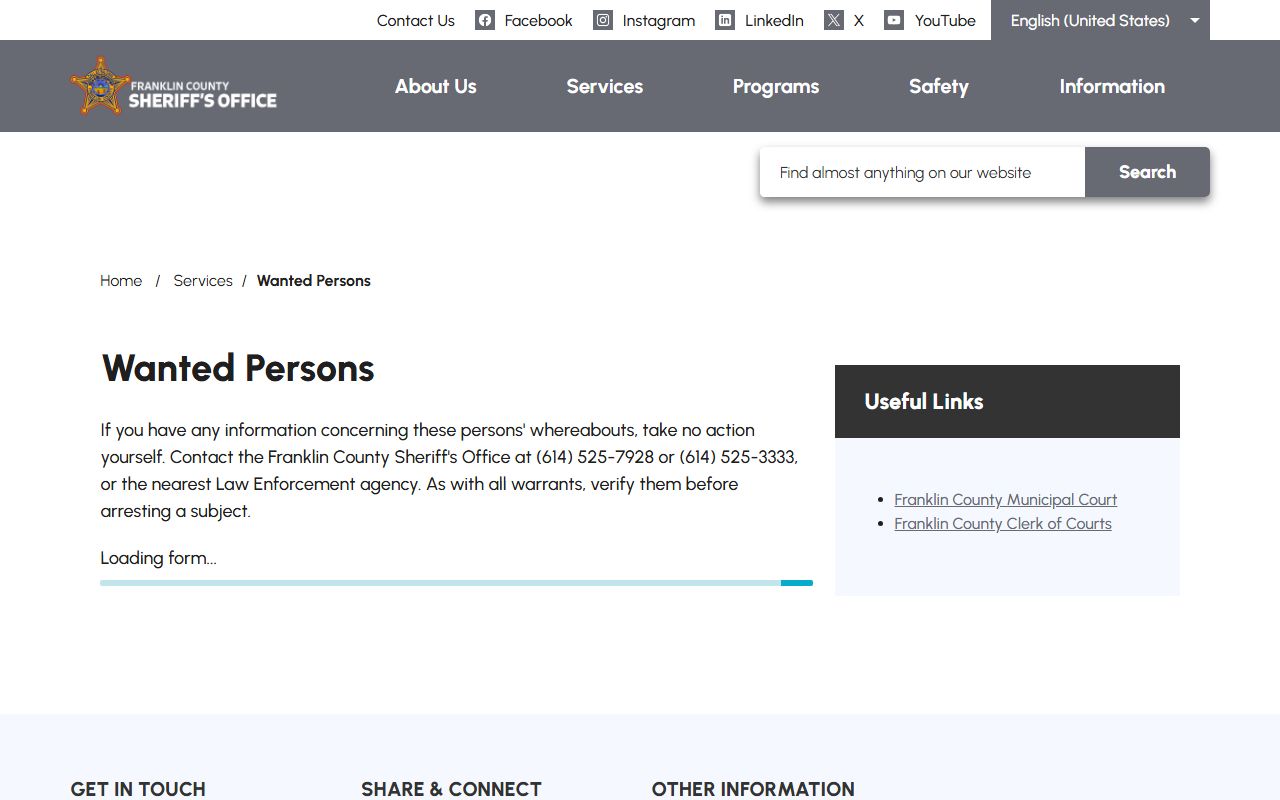
The page asks anyone with information on a wanted person's whereabouts to call the Sheriff's Office at 614-525-7928 or 614-525-3333, or to call the nearest law enforcement agency.
Where Franklin County Warrant Records Appear
Warrant data lives in more than one place, and the format differs by source. The Sheriff page is built for wanted persons, not a fill-in search form. Court warrant entries appear as docket events inside Case Information Online for Common Pleas and inside the Municipal Court Clerk search for lower-court cases. The table below sums up what each official source exposes and how the controls work.
| Source / Field | Type | Required | Notes / Format |
|---|---|---|---|
| Wanted persons list/search | Dynamic page | Unspecified | Official public wanted persons page; exact controls are not exposed in the static page. |
| Municipal case search | Case search | Conditional | Warrant status may appear in Municipal results; search by name, case, or ticket. |
| CIO criminal search | Case search | Conditional | Criminal Common Pleas dockets may show warrant or capias events. |
So the Sheriff page is a list to read, while the two court tools are searches you run by name or case number. Warrant status on a court case shows up as a docket line, not a separate database all its own.
Types of Franklin County Warrants
Not all warrants mean the same thing. Some come from a criminal charge. Some come from a missed court date. Knowing the type tells you which court and which clerk to call. Ohio courts use a few common terms, and Franklin County dockets reflect them. The list below breaks down the main kinds you may run into during a warrant search, and how each one tends to start.
- Arrest warrant - An order to arrest a person based on a criminal charge and probable cause.
- Bench warrant - Issued by a judge after a missed court date, a failure to comply, or contempt.
- Capias - The Ohio court term for a warrant to bring someone before the court, often after a failure to appear.
- Search warrant - Authorizes a search or seizure under Ohio Revised Code § 2933.23; it may stay sealed until executed and returned.
- Civil warrant or process - Court process the Sheriff enforces, such as child-support contempt or debt and garnishment matters.
A capias and a bench warrant overlap a lot in everyday court talk. Both can issue when a person does not show up or does not do what the court ordered. The Municipal Court Clerk also notes that its office keeps the actual search warrants, subpoenas, and pleadings filed in those cases, alongside the rest of the record.
Note: A search warrant may not be public before it is served, so do not expect to find one online while an investigation is still active.
Searching Court Dockets for Franklin County Warrants
If the warrant is tied to a court case, the docket is the place to look. For felony and larger civil matters, the Clerk of Courts runs Case Information Online, which can show capias and warrant events on a criminal file. For traffic, misdemeanor, and small civil matters, the Municipal Court Clerk search may flag warrant status next to the case. You search both by name or by case number.
A name search returns a longer list, so add a court type or a date range to trim it. A case number gives the cleanest single result. The Municipal Clerk says you can start with a case number, a ticket number, a last name plus first name, or a company name. Once the file opens, read the docket entries in date order to spot a capias, a bench warrant, or a clearance.
You can reach these tools from the related pages on this site. See the Franklin County court records search guide for the Common Pleas portal, and the arrest records page for how charges and bookings connect to a warrant.
Warrant clearance can lag online. A judge may recall a warrant in the courtroom, but the docket update can take time to post, so recheck the file later or call the clerk.
How to Resolve a Franklin County Warrant
An open warrant does not go away on its own. The faster path is to confirm the warrant, learn which court holds it, and deal with it head-on, ideally with a lawyer if a criminal charge is involved. The steps below follow the order the county offices suggest. Start with the right search, then move to the right phone call.
- Do not rely on unofficial warrant aggregators or pay-to-view sites.
- Search the Municipal Court if the matter is traffic, misdemeanor, or civil under Municipal jurisdiction.
- Search Case Information Online if it is a felony or Common Pleas case.
- Call the Clerk for case-specific bond and court-date information.
- Call the Sheriff's Office or local law enforcement for wanted-persons or Sheriff warrant questions.
- Talk to counsel before appearing if the warrant involves a criminal charge.
- If bond is set, verify the amount and the payment process through the right clerk.
- After the matter is handled, recheck the docket because warrant clearance may not show online right away.
Each step points to a real office in Columbus. The point of contact for a wanted person is the Sheriff's Office. The point of contact for a court warrant is the clerk that holds the case.
Checking Bond on a Franklin County Warrant
Bond is the money or set of conditions that secures release and a promise to appear. People often want the bond amount the moment they learn of a warrant. The catch is the source. The Sheriff's online inmate system shows current charges, case numbers, location, and court dates, but the Sheriff warns that bond information should be verified through the Clerk of Courts. So the jail roster is a start, not the final word on bond.
For a Common Pleas case, the Clerk of Courts is the bond authority, reachable through the Legal Division at 614-525-3600. For a Municipal case, the Municipal Court Clerk holds the bond and cost records. Always confirm the figure with the clerk before anyone pays, since amounts and conditions can change as a case moves.
- Bond
- Money or conditions that secure release and a court appearance.
- Surety
- A third party or bonding company that guarantees the bond.
- Recognizance
- Release on a written promise to appear, subject to conditions.
- Capias
- A warrant or order to take a person into custody after a failure to appear or comply.
If a person is already in custody, the Franklin County inmate records search shows the current booking, charges, and court dates while you confirm bond with the clerk.
Public Access to Franklin County Warrant Records
Ohio law presumes court records are open, and warrant entries on a case docket follow that rule. Access runs through the Ohio Public Records Act and the court-access rules. Some warrant material is held back, though. A search warrant can be sealed while an investigation is active. Sealed and expunged cases drop out of public view once a court grants the order.
When a record is sealed, the law still lets certain officials and the subject of the record inspect it in limited cases. The Ohio inspection-of-sealed-records statute spells out those narrow exceptions. That is why a sealed warrant file is not simply gone for every purpose, even after a court closes public access to it.
Ohio Revised Code § 2953.34 sets the rules for inspecting sealed records and the limits that apply after a sealing order.
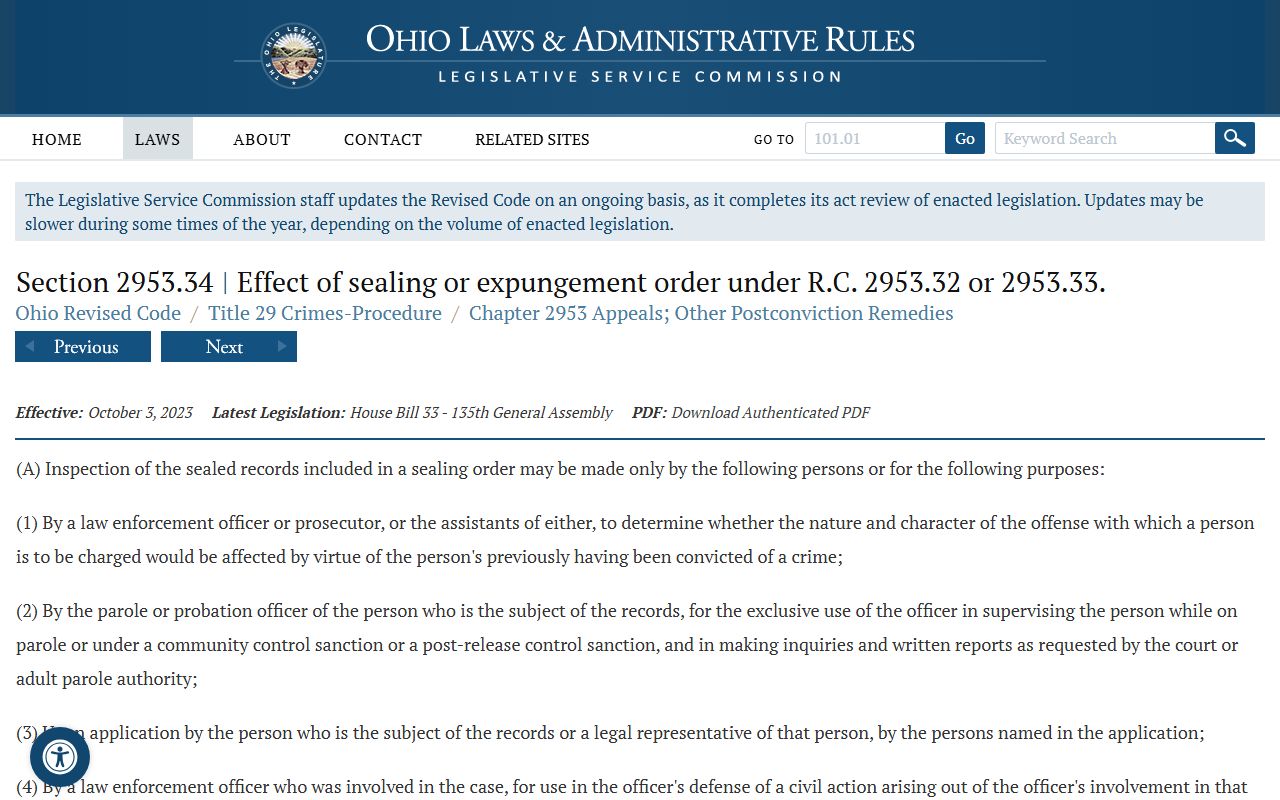
So a clean public search may still miss a sealed file, and that is by design under state law.
Requesting Sheriff Warrant Records in Franklin County
Some warrant and incident information is held by the Sheriff rather than a court. For those, the Sheriff's Office runs its own public records request process. You ask the Sheriff for public safety records, and the office releases what the law allows. This is the path for incident reports and certain Sheriff-held documents that are not part of a court docket.
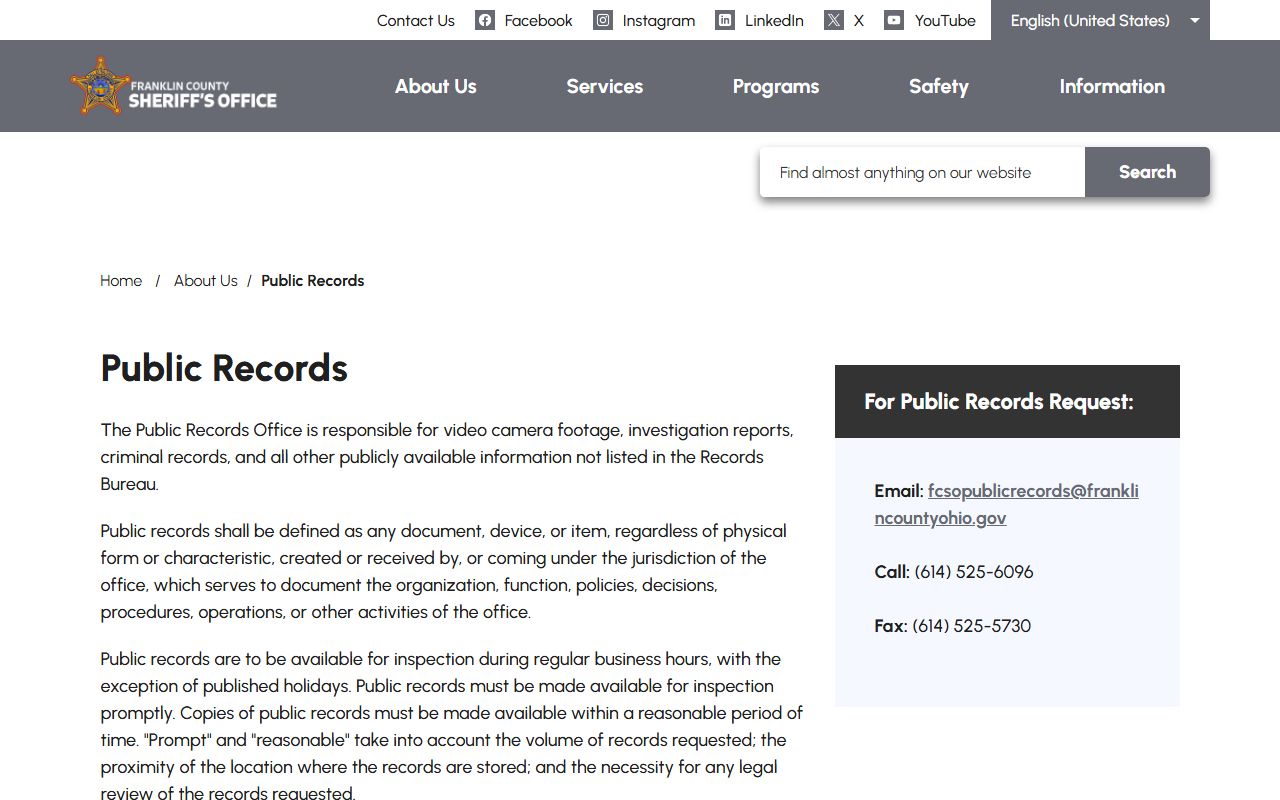
The Sheriff's public records page is the official place to send these requests.
The Franklin County Sheriff public records request page explains how to ask the office for its public safety records.
For court warrant entries, though, use the clerk that holds the case instead, since the Sheriff does not control the court docket.
Avoiding Franklin County Warrant Scams
Warrant scams are common, and they prey on fear. The Municipal Court Clerk has posted alerts about texts that claim you owe money for unpaid parking tickets and demand fast payment through a link. Real Franklin County courts do not text you a link to clear a warrant. Pay only through official court channels. Never send gift cards, wire transfers, or crypto to settle a warrant.
If a message or call worries you, do not click and do not pay. Look up the case yourself through the official Municipal or Common Pleas search, or call the clerk's published number. A genuine warrant will show on the docket or with the office that issued it.
- The county will not demand payment by gift card, wire, or crypto.
- Official searches are free; a fee to view a warrant is a red flag.
- Verify any warrant claim through the clerk's published phone line.
- Report suspected scams to the court and to local law enforcement.
When in doubt, go straight to the source. The clerk and the Sheriff can tell you whether a warrant is real.