
Franklin County Marriage License Office
Marriage licenses come from the Franklin County Probate Court. The Marriage Department sits on the 23rd floor at 373 South High Street in Columbus. Hours run Monday through Friday, 8:00 a.m. to 4:30 p.m. The last license of the day goes out at 4:00 p.m., and both parties must be present at that time. The court closes on legal holidays the county recognizes.
Not everyone can get a license here. Probate issues them to Franklin County residents who plan to marry in Ohio. Out-of-state couples may still get a Franklin County license, but only if the ceremony will take place in Franklin County. So venue matters as much as where you live. Every applicant must finish the online application before showing up in person, and the license stays valid for 30 days once issued.
The Marriage Department page lays out the hours, fees, and the rule that both people appear together.
The Franklin County Probate marriage license page covers eligibility, hours, and the online application step.
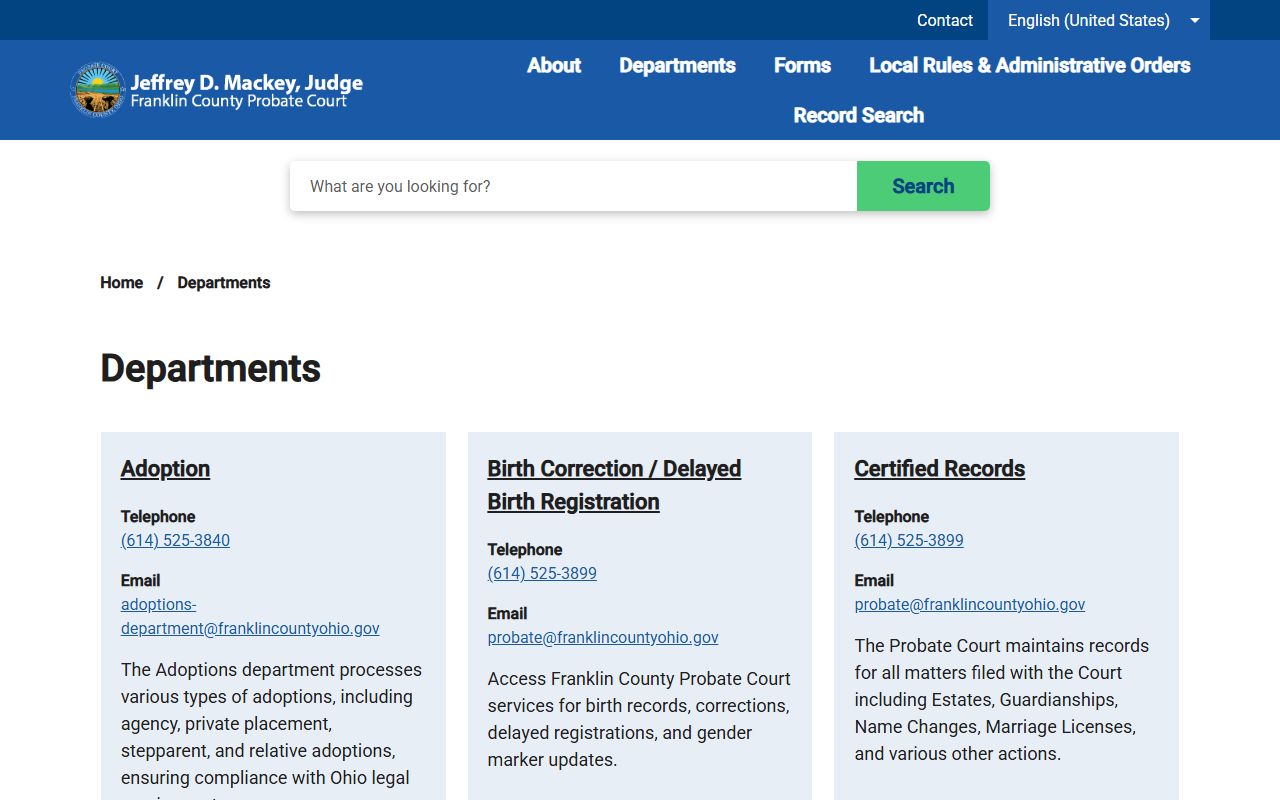
The same page links the online form you start before your visit.
How to Apply for a Marriage License
The process mixes an online step with an in-person visit. You start at home, then both parties finish at the counter. The court will not issue a license unless both people are there before the 4:00 p.m. cutoff. Plan the trip with that deadline in mind.
- Confirm you qualify: a Franklin County resident marrying in Ohio, or an out-of-state resident marrying in Franklin County.
- Complete the online application before you appear in person.
- Both parties go to the Probate Marriage Department before 4:00 p.m. for issuance.
- Bring the identification and documents listed on the Probate requirements page.
- Pay the $65 fee by cash or credit/debit card.
- Have an authorized officiant solemnize the marriage.
- The officiant signs the license and returns it to the court.
- Order a certified marriage abstract later if you need proof of the marriage.
The license must be used within the 30-day window. If the ceremony slips past that, the license expires and you start over.
Note: Both parties must appear together at the Probate counter, and the last license each day is issued at 4:00 p.m. sharp.
Franklin County Marriage Record Fees
The cost side is short and clear. The license itself is a flat fee. Certified abstracts, the proof-of-marriage copies, run a small charge per copy. Card payments add a transaction fee that the bank sets, and that piece is not refundable.
| Item | Fee |
|---|---|
| Marriage License | $65.00 |
| Certified Marriage Abstract | $2.00 per copy |
| Credit/Debit Transaction Fee | Set by the bank; non-refundable |
You can pay the license fee by cash or by credit or debit card. Once the officiant returns the signed license, you may order certified abstracts in person, online, or by USPS mail. Most legal and out-of-state uses ask for a certified abstract, not a plain printout.
Franklin County Marriage Records Search
Probate runs a Marriage License Search for the public. The online index covers records from January 3, 1995 to the present. It is a name-based lookup with a simple set of fields. The data is current as of the previous day, so a brand new license may not show right away.
You search by entering a name and, if you want, a date the license was issued. The court asks for the name in Last Name, First MI format. That keeps results tied to the way the file is stored.
The Marriage License Search page holds the form and the same maintenance notice the Probate portals share.
The Franklin County Probate marriage license search is the free public index for records from 1995 forward.
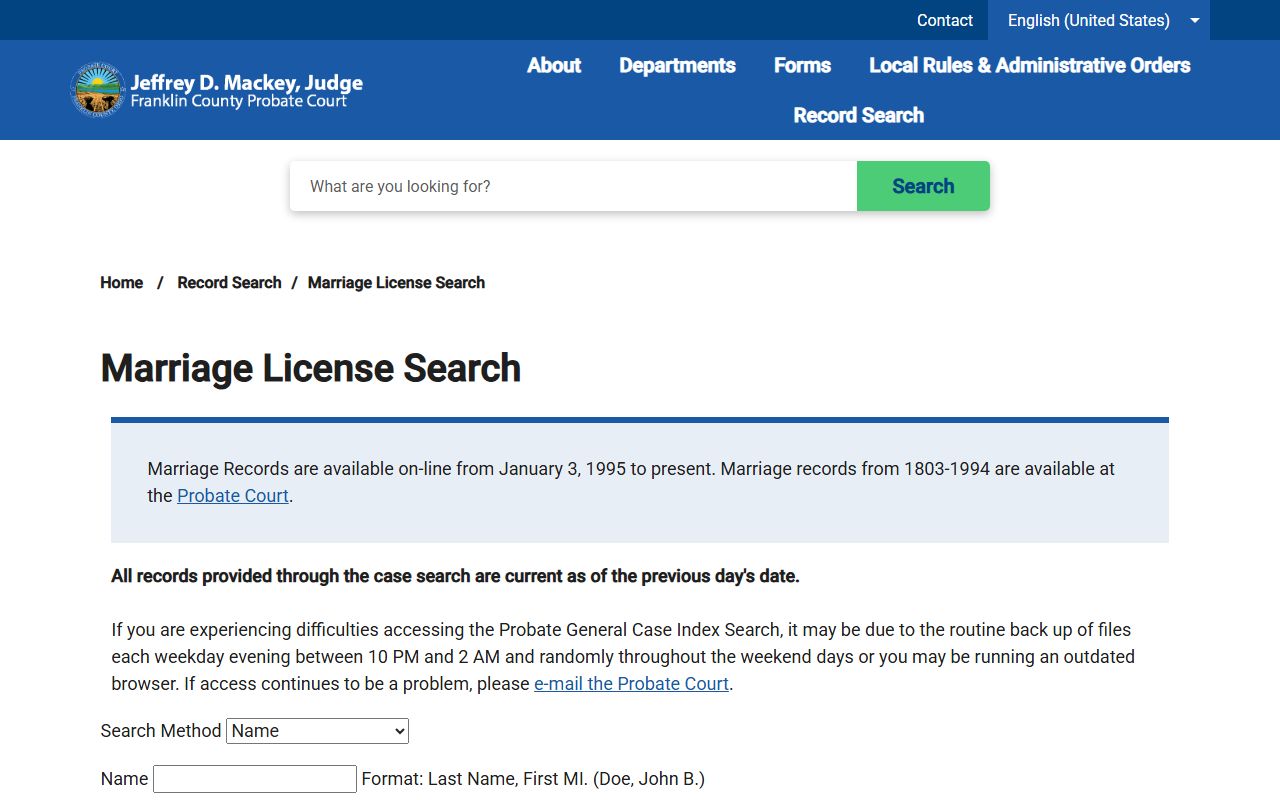
The fields below come from the live marriage search form.
| Field Label | Type | Required | Notes / Format |
|---|---|---|---|
| Search Method | Dropdown | Pick one | Select how you want to search. |
| Name | Text | Method-based | Format: Last Name, First MI. |
| License Issued Date | Date | No | MM/DD/YYYY format. |
Franklin County Marriage License Eligibility
The Probate Court sets who can get a license and where the wedding can happen. The court issues licenses to Franklin County residents who plan to marry in Ohio. It also issues a license to out-of-state residents, but only when they plan to marry in Franklin County. A license is good for 30 days, so the timing of the application matters.
Both parties complete the online application first, then appear in person at the Marriage Department. Both must be present when the license is issued, and the last license each day goes out at 4:00 p.m. You can pay the fee by cash or by credit or debit card. Bring the identification the court asks for, since staff confirm identity and the facts on the application before issuing the license.
Ordering a Certified Marriage Abstract
A certified marriage abstract is the proof most agencies accept. After the ceremony, the officiant signs the license and returns it to the court to confirm the marriage. Once that signed license is back on file, either party can order a certified abstract. The court offers ordering in person, online, or by mail through the U.S. Postal Service.
Each certified abstract costs $2.00 per copy. People often need an abstract for a name change, a Social Security update, a passport, or insurance and benefit claims. Keep a couple of certified copies on hand, since many offices want their own. A plain printout from the online index is not the same as a certified abstract and is not accepted as legal proof.
Historical Franklin County Marriage Records
The online index does not reach all the way back. Marriage records from 1803 through 1994 are not in the public search tool. Those older records sit at the Probate Court itself. Depending on age, a record may be in a bound book, on microfilm, on microfiche, or as a scanned image.
For anything before 1995, you contact Probate directly rather than the website. The certified records desk can pull and certify an older marriage record. Genealogy researchers and people settling estates often need these older files, so the court keeps the full historical run.
Note: Marriage records before 1995 are held at the Probate Court and are not part of the online search, so older requests go through the certified records desk.
Franklin County Divorce and Dissolution Records
Divorce records live on the family side of the courts, not at Probate. Ohio recognizes both divorce and dissolution. A dissolution is the no-fault path where both spouses agree on terms first. A divorce is the contested or fault-based path. The Domestic Relations and Juvenile Branch hears these cases, along with custody, support, parenting time, and protection orders.
Case documents for divorce and dissolution are routed to Case Information Online, the same public search the Clerk of Courts runs for Common Pleas. In that portal, dissolution cases carry the code DM and divorce cases carry the code DR. To pull a family case, set the Court dropdown to Domestic, or enter the case number if you have it.
- Open Case Information Online from the Clerk of Courts.
- Search by name with the Court set to Domestic, or by case number if known.
- Use DM for a dissolution or DR for a divorce when you search by case number.
- Review the docket for filings, orders, and the final judgment entry.
- For certified copies or files not online, contact the Domestic Relations Clerk.
Some child and financial identifiers may be redacted or sealed. The public docket still shows the filings, the parties, and the outcome, but sensitive detail can be held back. For deeper help with the case search itself, see the Franklin County court records guide and the Court of Common Pleas page.
Domestic Relations Clerk Contact
The Domestic Relations Clerk holds the certified divorce and dissolution files. When a record is not online, or when you need a copy with the clerk's seal, this is the office to call or visit. Bring the case number if you have it, since that gets you the fastest result.
Domestic Relations Clerk
373 South High Street, 4th Floor
Columbus, OH 43215
614-525-4410
The court system also runs a separate site for family and juvenile matters, where you can read the public records policy that governs which divorce and custody files are open.
You may also want the county's probate records for estate and guardianship files, or the broader public records page for open-records requests. The Clerk of Courts page explains certified copies in more detail.