
Ohio Public Records Act and Franklin County
Ohio access to government records is mainly governed by the Ohio Public Records Act. The law defines a public record, lists the exemptions, and requires prompt inspection and copies within a reasonable time. It also allows cost-based copy charges and points offices to keep a public-records policy. Franklin County offices follow this state framework. The Clerk of Courts, for one, mirrors the rule in its own posted policy.
Anyone can ask. You do not need to be a county resident, a party to a case, or a lawyer. The Public Records Act draws no line based on who you are. The key duty falls on the office to release records it holds, unless a statute, a rule, or a court order makes the record confidential.
Ohio Revised Code § 149.43 is the central Public Records Act, with its current official text effective in 2025.
Court records add a second layer. They are governed by the Ohio Rules of Superintendence 44 through 47, which set the presumption of access and the rules for redaction. So a court file is open, but it is handled under court rules rather than the ordinary executive-branch process.
Court Record Access Rules in Franklin County
The Rules of Superintendence treat court records a bit differently from other government files. Sup.R. 44 defines what counts as a court record, a case document, and a personal identifier. Sup.R. 45 creates the presumption of public access and sets inspection and copy standards during business hours. Sup.R. 46 governs how courts manage and retain records, which is why older files may sit on microfilm, microfiche, or as scanned images. Sup.R. 47 sets the process to restrict access when privacy or safety outweighs the presumption of openness.
This matters when you request a Franklin County court file. The presumption is open access, but the court must redact information that the rules or a statute protect. Personal identifiers like Social Security numbers are removed. If part of a file is restricted, the public portion is still released.
The full text of these rules is published by the Supreme Court of Ohio for anyone who wants the source.
You can read the Ohio Rules of Superintendence 44 through 47 for the exact court-record access standards.
What the Franklin County Clerk Maintains
The Clerk of Courts holds a wide set of public records beyond the courtroom. The office is the keeper of records for the Court of Common Pleas and the Tenth District Court of Appeals. It also runs the Auto Title division. So a single office covers civil and criminal case files, appeals, fiscal records, and motor vehicle titles. Other offices hold their own slices.
Knowing the custodian saves a wasted request. The list below shows which Franklin County office keeps which public records.
- Clerk of Courts - Common Pleas civil and criminal, Domestic Relations, Juvenile, Tenth District appeals, fiscal records, and Auto Title records.
- Municipal Court Clerk - Municipal civil, criminal and traffic, small claims, environmental cases, search warrants, subpoenas, garnishments, fines, and costs.
- Probate Court - Marriage licenses and records, estates, guardianships, name changes, and historical birth and death records from 1867 to 1908.
- Sheriff - Inmate booking and custody records, incident and public safety records, and wanted persons information.
The Clerk's posted public records policy is the official statement of how the office handles a request.
The Franklin County Clerk public records policy sets out inspection hours, request rules, and how the office processes copies.
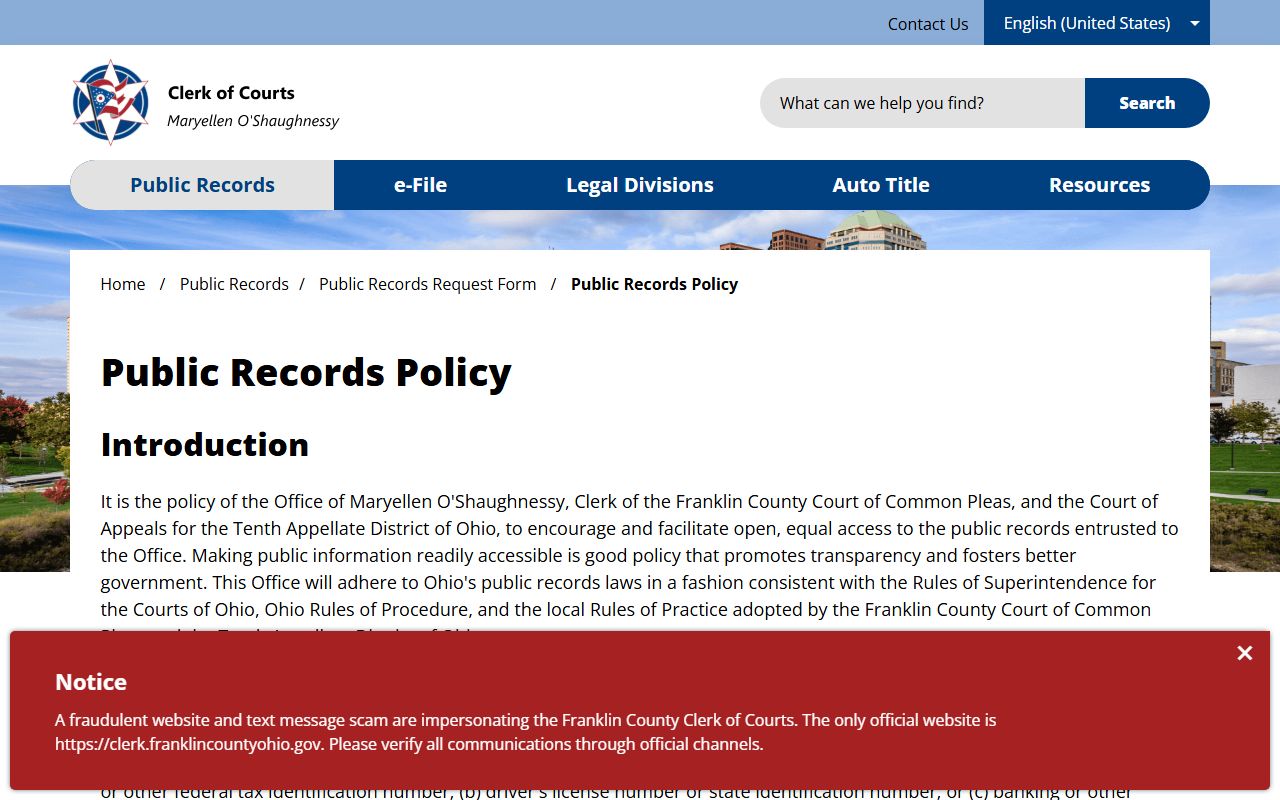
The policy makes clear that records can be inspected for free during regular business hours.
How to File a Franklin County Public Records Request
The process is simpler than many people expect. Under Ohio law and the Clerk's policy, you do not have to put the request in writing, you do not have to identify yourself, and you do not have to state a purpose. Staff may ask for more detail only if a request is too vague to fill. The one real duty on your side is to describe the records clearly enough that the office can find them.
- Identify the office that holds the record, such as the Clerk of Courts, the Municipal Clerk, Probate, or the Sheriff.
- Describe the records with enough detail, using a case number or a name and date range where you can.
- Send the request in person, by phone, by mail, or through the office channel, since writing is not required.
- Respond if staff ask you to clarify a vague request.
- Pay any copy or certification fee quoted, then receive the records in your chosen format where reasonable.
For court files, you can often skip the formal request and just search online. The Clerk's Case Information Online and the Municipal Court Clerk search return most case data for free.
Note: You can inspect Franklin County public records without giving your name, but the request must describe the records clearly enough for staff to locate them.
Franklin County Public Records Request Fields
Even though no form is required, it helps to include the details an office needs to act fast. The Clerk's policy frames a request around a clear description rather than a fixed form. The table below lays out the fields drawn from that policy and what each one does for your request.
| Field Label | Required | Notes / Format |
|---|---|---|
| Request description | Yes in practice | Must identify records with sufficient clarity; no magic words required. |
| Requester name | No | Policy says you do not need to prove your identity. |
| Contact information | Optional but useful | Needed only if the office must clarify or deliver records. |
| Purpose of request | No | The office generally does not inquire about purpose. |
| Delivery medium | Optional | Paper, electronic, or other reasonably duplicable medium under the Public Records Act. |
So the only field that truly matters is the description. The rest just helps the office reach you or send the file in the form you want.
Response Timelines for Franklin County Records
Ohio law does not fix a single deadline in hours. It requires that records be made available promptly for inspection and that copies follow within a reasonable period. What is reasonable depends on the request. The Clerk's policy says records under 20 pages or readily available in electronic form are processed as fast as staff and equipment allow.
Larger requests can take longer. Volume, storage location, and any legal review for redaction all add time. A file kept on microfilm or in off-site storage will not come back as fast as a recent electronic docket. If part of a record is exempt, the office releases the public portion and explains the redaction with its legal basis.
For court files, the fastest route is usually the online search rather than a formal request, since the data is already posted.
Franklin County Public Records Fees
Inspection is free. You pay only for copies, and the charge is cost-based, as the Public Records Act allows. Fees differ by office and by record type. Court case copy and certification fees are quoted at the counter by the clerk that holds the file. The Auto Title division publishes a set copy fee. The table below shows the fee points the county has posted.
| Item | Fee / Note |
|---|---|
| Public inspection | Free during regular business hours |
| Copies under 20 pages / readily electronic | Processed as fast as equipment and staff allow |
| Auto title record copy | $5.00 |
| Auto title in-person payment | Cash, check, money order, or credit card with a 3% processing fee |
| Court case copy / certification | Quoted by the clerk at the counter |
If you need a certified copy, ask the right clerk and plan to pay the certification fee on top of the copy cost. A plain printout from the online docket carries no fee but is not accepted as proof in court.
Records That Are Exempt in Franklin County
Not every record is open. The Public Records Act lists exemptions, and court rules add their own protections. Some files are confidential by statute. Probate states that adoption, mental illness, and developmental disability records are confidential by law and not open for public inspection. Juvenile records carry tight limits. Sealed and expunged criminal records drop out of public access once a court grants the order.
Other categories are held back too. Grand jury materials are generally not public before an indictment. A search warrant may be sealed during an active investigation. Personal identifiers such as Social Security numbers and financial account numbers are redacted from filings. Trial preparation and attorney-client material is excluded from ordinary release.
When part of a record is exempt, the office does not deny the whole file. It releases the public portion and explains each redaction with the legal authority behind it.
If Your Franklin County Request Is Denied
A denial is not the end of the road. Ohio gives requesters a streamlined path through the Ohio Court of Claims. This public-records dispute procedure is faster and cheaper than a full lawsuit. It supplements, rather than replaces, the older mandamus route in court. A requester uses it when an office denies access or fails to respond properly.
The Court of Claims process is set out in statute and is built for everyday requesters, not just lawyers.
Ohio Revised Code § 2743.75 provides the Court of Claims procedure for resolving public-records disputes.
Before you file, confirm you asked the right office and described the records clearly. Many denials come down to a vague request or the wrong custodian, both of which are easy to fix.
Municipal Court Public Records and Retention
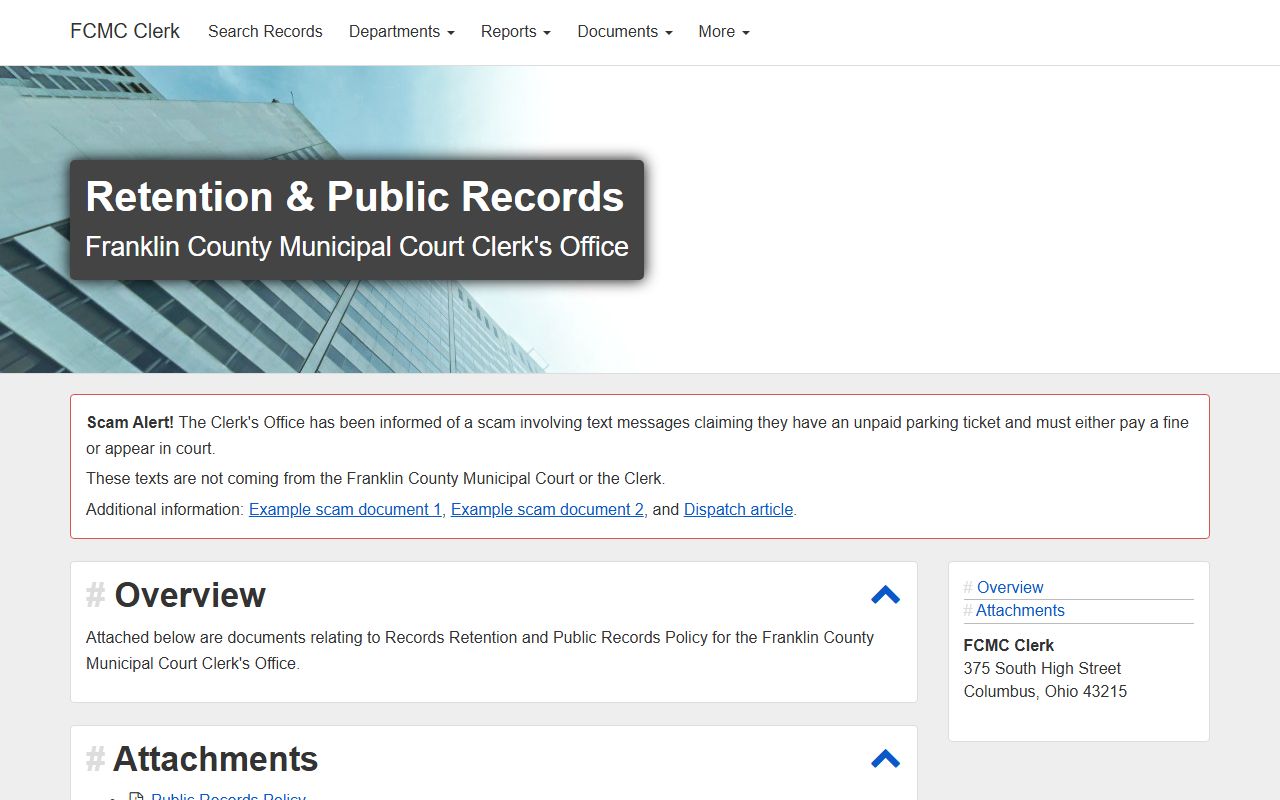
The Municipal Court Clerk keeps its own public records and follows its own retention schedule. The office is the legal guardian and keeper of all official records of the Franklin County Municipal Court. That includes criminal and civil case filings, search warrants, subpoenas, pleadings, and money records like court costs, fines, and garnishments. So a Municipal case request goes to this office, not the Clerk of Courts.
The Municipal Clerk publishes a page on public records and retention that explains how long records are kept and how to ask for them.
The Franklin County Municipal Court Clerk public records and retention page covers the office's record-keeping and request process.
Match the court to the clerk, and your Municipal request lands in the right place the first time.